
2026 Customer Loyalty Strategy Resource Hub
Loyalty evolves faster than many brands expect. And let’s be honest: marketing teams often sprint through planning season only to discover later that some expectations didn’t survive contact with real customers. The leaders who keep checking their footing tend to catch opportunities others miss. That’s why we created this Customer Loyalty Strategy Resource Hub for 2026. Everything here gives you space to stress-test the thinking behind your program and surface weak spots before anything’s put into motion. So, grab your team, a whiteboard, and your favorite dry-erase markers. It’s time to see how your customer loyalty strategy for 2026 stacks up.
TABLE OF CONTENTS
Loyalty Strategy Fundamentals
What Is Customer Loyalty?
Customer loyalty shows up when people return to your brand because the experience feels steady and worth repeating. They trust what you offer, and that trust grows each time you meet their expectations. Even when a competitor tries to lure them away with a lower price, they don’t budge. You’re reliable when they need you most, and it’s that relationship that does the loyalty heavy lifting.
How Is Loyalty Different From Rewards?
Rewards motivate behavior, but they don’t automatically create loyalty. A discount or perk is great and might spark a quick transaction, but incentives and the instant gratification they bring fade. Only trust and emotional connection build lasting relationships and keep customers coming back.
Why This Matters
When rewards blur into bribes, budgets get swallowed by short-term spikes that fade as fast as they appear. It’s far better to pour energy into experiences that feel personal and surprising, because that’s where genuine attachment grows. Not from shaving a few dollars off a cart, but from giving people a reason to care long after the promotion expires.
What a Good Loyalty Strategy Looks Like

IT’S ROOTED IN CUSTOMER VALUE
Real loyalty comes from knowing what people truly value when they’re with you. Some want things to feel easier; others like a bit of recognition or the sense of getting something they wouldn’t find elsewhere.

IT MOTIVATES MEANINGFUL BEHAVIOR
A good loyalty strategy encourages the behaviors that matter most to your business. More visits, bigger baskets, deeper engagement, referrals, product adoption, or sticking around instead of slipping away — focus on whatever drives momentum.

IT’S WEIGHTED BY CUSTOMER IMPACT
Focus on leaning toward the customers who drive the most value and shape experiences around what resonates with them.

IT CONNECTS DATA TO ACTION
A strong program reads customer behavior and preferences closely enough to deliver offers and moments that will land. Turn insights into action instead of leaving them sitting in a dashboard.

IT ALIGNS BENEFITS WITH BUSINESS OUTCOMES
The rewards you offer should reinforce profitable behavior as opposed to working against your margins. A good loyalty strategy balances customer delight with financial discipline.

IT CREATES EMOTIONAL CONNECTION
The best programs mix practical benefits with the kind of emotional pull that keeps people close. Recognition, identity, a sense of belonging, or community all add weight to the experience.
Loyalty Program Types Overview
Loyalty programs come in many shapes, and each one works a little differently. Before you decide what’s right for your brand, it helps to understand the common models and how they influence customer behavior.
1. POINTS-BASED PROGRAMS
Members earn points for purchases or behaviors and redeem them for rewards. Good for brands with frequent transactions and broad product ranges.
2. TIERED PROGRAMS
Benefits increase as customers reach higher levels of engagement or spend. Best for motivating progression and rewarding high-value customers.
3. CASH-BACK/VALUE-BACK PROGRAMS
A simple percentage is returned to customers as store credit or discounts. Works well when simplicity and instant value matter most.
4. SUBSCRIPTION OR PAID MEMBERSHIP PROGRAMS
Customers pay a fee (monthly or annually) for premium benefits. Ideal when perks offer clear, ongoing value (e.g., convenience, shipping, exclusivity).
5. PUNCH-CARD/VISIT-BASED PROGRAMS
Customers earn a reward after a set number of purchases or visits. Effective for high-frequency, low-ticket businesses like coffee shops or quick-service restaurants.
6. EXPERIENTIAL LOYALTY PROGRAMS
Focus on exclusive access, events, VIP treatment, or community benefits rather than discounts. Best for brands with strong lifestyle or identity appeal.
7. COALITION OR PARTNER PROGRAMS
Multiple brands share earnings and redemption across a network. Works well when customers benefit from broader utility and partners share similar audiences.
8. HYBRID PROGRAMS
Blend two or more program types (e.g., points + tiers, cashback + subscription perks). Useful when a single structure can’t meet all customer needs.
Emotional vs. Behavioral Loyalty
Not all loyalty is created equal. Some customers keep coming back because they genuinely love your brand, while others return out of habit or for the perks. This quick comparison helps you understand the difference.
| EMOTIONAL LOYALTY | BEHAVIORAL LOYALTY |
|---|---|
| Driven by genuine connection, identity, trust, or shared values. | Driven by habits, incentives, convenience, or ease of purchase. |
| Customers stay because they want to. | Customers stay because it’s rewarding or easy. |
| More resilient to competitors, price changes, and market fluctuations. | Highly sensitive to better deals, convenience shifts, or friction. |
| Built through recognition, community, brand experience, and meaning. | Built through points, discounts, reminders, and routine behaviors. |
| Leads to advocacy, referrals, and premium willingness to pay. | Leads to repeat purchases but not necessarily deeper loyalty. |
Diagnose Your Loyalty Performance
How to Fix Your Loyalty Strategy
The best way to build or repair customer trust is to stop treating the symptoms and focus on the cure. Unified audience intelligence informs what customers value. Expectation design ensures every channel communicates and delivers consistently on those truths. Meaning, you need a shared understanding of your customer, and you need to design expectations every channel can keep.

BUILD A SHARED CUSTOMER TRUTH
Create one shared customer truth and map the expectations it naturally sets. This becomes the common understanding of what customers believe you stand for. When your internal team works from the same truth, it’s much easier to anticipate what customers expect next.

CHECK YOUR MESSAGES AGAINST THOSE EXPECTATIONS
Audit channel messages and policies against those expectations and identify mismatches. This helps you spot where your words promise one thing, but the experience delivers something different. Fixing these disconnects builds trust and reduces customer frustration.

INTERPRET SIGNALS TOGETHER
Have cross-functional teams co-interpret customer signals and decide what expectations the next initiative will create. When teams read the signals together, they avoid making isolated decisions that confuse the customer. This shared view keeps new initiatives aligned with what customers already assume or hope will happen.

STRESS TEST YOUR LOYALTY IDEAS
Pressure-test loyalty offers against both the customer motivations and the operational ability to deliver. A great offer only works if it resonates with customers and can actually be executed consistently. This step saves teams from launching loyalty promises that sound good but fall short in practice.

ESTABLISH YOUR NON-NEGOTIABLE EXPECTATIONS
Set non-negotiable expectations tied directly to core customer insights. These are the expectations customers absolutely count on you to meet. Making them explicit and consistent helps every team deliver on the moments that matter most.

FIX THE BIGGEST GAPS FIRST
Prioritize fixes where audience truths and expectations diverge most sharply. These high-friction gaps often cause the most confusion or disappointment. Tackling them first creates quick wins that improve confidence and strengthen long-term loyalty.
8 Ways to Increase Customer Loyalty Through Customer and Employee Experience
Great customer loyalty starts with great service, and that only happens when employees feel supported and set up to succeed. When you treat your team with the same care you bring to customer experience, you create a loop where engaged employees deliver better interactions that build trust. Here are eight ways to strengthen loyalty by improving both the employee and customer experience.
1. PERSONALIZE
- Customers: Personalized experiences rooted in zero-party data help you tailor recommendations and timely interactions to each customer’s unique journey.
- Employees: Investing in a well-chosen CRM system and offering personalized development opportunities gives employees the insight they need to deliver stronger customer experiences.
- Connection: By building customer profiles and developing messaging and training around them, you can empower your employees to make decisions
2. PROVIDE A CONSISTENT EXPERIENCE
- Customers: Give customers a consistent brand experience by connecting your online and offline marketing and using interaction data to personalize what each person sees.
- Employees: Keep communication flowing across departments, so employees stay aligned and can support one another more easily.
- The connection: When customer-facing teams share information and use a CRM to keep everything consistent, the experience feels smoother for the customer and encourages them to come back.
3. INVEST IN AND UTILIZE TECHNOLOGY
- Customers: Use technology to anticipate customer needs and deliver faster, more personalized support across every channel they use.
- Employees: Give employees tools that simplify their work and surface clear data so they can spend more time delivering helpful, high-quality service.
- The connection: When technology makes life easier for both employees and customers, it creates a cycle of better service and stronger loyalty.
4. GATHER AND ACT ON FEEDBACK
- Customers: Use customer feedback to spot patterns and guide smarter decisions that keep your experience feeling more relevant and satisfying over time.
- Employees: Listen to employee feedback so you can build a workplace that supports them and keeps them motivated to deliver great service.
- The connection: When you gather feedback from both customers and employees and act on what you learn, you create a healthier system that supports strong relationships and loyalty on both sides.
5. INCENTIVIZE AND REWARD
- Customers: Offer meaningful discounts or perks in exchange for data to keep customers engaged during tough times while still gaining insights that support your loyalty strategy.
- Employees: Provide incentives that show employees their work matters and give them real reasons to stay committed and perform at a high level.
- The connection: When you reward both customers and employees in thoughtful ways, you create a cycle where motivated teams deliver better experiences that strengthen loyalty.
6. COMMUNICATE BRAND PURPOSE
- Customers: Keep customers connected to your brand by sharing your purpose and showing how your work makes a positive impact in ways that matter to them.
- Employees: Help employees feel more invested by clearly communicating the brand’s purpose and showing how their work contributes to something meaningful.
- The connection: When customers and employees understand and believe in your purpose, they form a stronger bond with your brand and are more likely to stay loyal.
7. MAINTAIN CONSISTENT COMMUNICATION
- Customers: Stay present with customers by sharing useful updates and responding quickly to show you care about their experience.
- Employees: Keep employees informed and supported through open communication so they feel engaged and ready to deliver great service.
- The connection: When both customers and employees feel in the loop, trust grows, and the overall experience becomes smoother and more satisfying.
8. EMPOWER YOUR EMPLOYEES TO HELP CUSTOMERS
- Customers: Give customers quicker, more effective help by empowering the people they speak to, so stressful moments feel easier to resolve.
- Employees: Support employees with the authority and training they need so they can solve problems confidently and feel good about the help they provide.
- The connection: When employees feel capable and customers feel respected, the overall brand experience improves and loyalty grows.
Loyalty Program Misalignment Signals Checklist
Use this checklist to catch early warning signals before they hurt retention or customer value. As you continue to refine your 2026 plan, you can review each item against your latest data to see what needs attention.
PARTICIPATION AND ENGAGEMENT BEHAVIOR
- Customers join the program but do not return after the initial enrollment
- Monthly or quarterly engagement trends are sliding in the wrong direction
- A large portion of members show little or no activity
REDEMPTION AND REWARD HEALTH
- Members earn points or rewards but rarely redeem them
- Redemptions cluster around only one or two reward types, indicating limited perceived value
- Reward inventory or reward messaging no longer reflects what customers want
COST AND RESOURCES INDICATORS
- Program costs rise without a matching increase in customer lifetime value
- A small group of high-cost members absorbs most of the benefits
- Incentive or reward structures rely heavily on discounts rather than meaningful value
CUSTOMER PERCEPTION AND EXPERIENCE
- Members say the program feels confusing or hard to use
- Customer service teams receive repeated questions about the same issues
- Surveys or reviews show that customers do not see the program as relevant
COMPETITIVE AND MARKET CLUES
- Competitors offer clearer or more appealing benefits
- Industry trends indicate a shift in what customers expect from loyalty programs
- Members migrate to competing brands even while enrolled in your program
INTERNAL EXECUTION SIGNALS
- Data gaps make it hard to measure the program’s true impact
- Teams struggle to keep up with communication, rewards, or fulfillment needs
- Leadership no longer sees the program as a source of strategic value
Benefit Relevance Snapshot
A quick snapshot of each benefit helps reveal whether your program reflects what customers find meaningful today. Use the table to note how often customers use a benefit, whether they see value in it, and whether it fits your brand promise. This gives you a simple way to spot which benefits are ready to protect, refine, or retire.
| WHAT TO REVIEW | WHAT TO LOOK FOR |
|---|---|
| Customer Use | Are customers choosing this benefit without heavy prompting or discount support? |
| Perceived Value | Do customers describe this benefit as helpful, meaningful, or worth the effort to redeem? |
| Brand Fit | Does the benefit reflect your brand promise or does it feel borrowed from a competitor? |
| Operational Load | Does this benefit strain your team or introduce avoidable friction for your customers? |
| Impact on Customer Value | Does this benefit increase frequency, satisfaction, or purchase quality? |
Customer Experience (CX) and Loyalty
How to Conduct a CX Audit
Customer experience drives performance and loyalty, making a full CX strategy essential for meeting rising expectations. Here are five steps to a good CX audit.

GATHER YOUR DATA SOURCES
Depending on your business, this might include retail store sales, seasonality, online sales reports, website traffic, ad schedules and performance, price promotion performance, etc., as well as data about reviews, customer sentiment (think social listening), call center activity, complaints to your customer service team, returns, and so on.

RUN A FRESH CSAT
If your data doesn’t include a recent customer satisfaction survey (not just net promoter score), then now is the time. These can be done online, affordably and swiftly, and customized for your business and competitive set. Or, if your most recent customer satisfaction survey is more than a year old, run a new one before the audit goes any further.

TALK WITH ACTUAL CUSTOMERS
For your CX audit, plan to talk to at least eight to 12 customers in depth. Mix recent buyers with long-time customers and people who used to buy from you and stopped. The lapsed group will tell you the most valuable things (and they’re also the hardest to convince to take the call — offer them something for their time).

MAP THE CUSTOMER JOURNEY AS A CHAIN
A customer journey map shows every meaningful interaction a customer has with your brand, in the order they happen. The metaphor most people use is a funnel, but a chain is more accurate, because the strength of the whole thing depends on the weakest link.

IDENTIFY THE WEAK LINKS
This is where the audit really pays off. Lay your chain alongside your data and your interviews, and look for the moments where customers are dropping out, getting frustrated, or going quiet without explanation.
8 Design Choices That Shape Your Website Customer Experience
With so much of life happening online, few websites feel personal, making a strong website customer experience essential for standing out. Here are eight website design elements to help you build trust with your audience.
- Simplicity and white space: A simple page with breathing room helps the reader focus on what matters. Resist the urge to fill every pixel; a page that has room to breathe feels more confident than one that crams in everything at once.
- Grouped information: People scan websites the way they scan a grocery store, so group related content together and keep your information architecture clear. Strong organization helps both visitors and search engines find what they came for.
- Intentional imagery: Choose images that show what you actually sell, the people behind your work, or the kind of customer you’re trying to reach. Stock photos of teams in headsets do not say “we are a serious company”; they say “we ran out of time.”
- Purposeful color: Color directs attention, sets tone, and signals brand. Pick colors that fit the emotional register of your content, then use them with discipline so important elements like buttons and links stand out.
- Mobile-first design: Most of your visitors are on a phone, so design for the smallest screen first and work up from there. If your site looks great on desktop and falls apart on mobile, you’re delivering a bad experience to most of your audience.
- Clear calls to action: Every important page should have an obvious next step, whether that’s a button, a form, or a phone number. Skip the clever copy: “Schedule a Consultation” beats “Let‘s Connect and See Where the Journey Takes Us” every time.
- Visible trust signals: Real testimonials, recognizable certifications, case studies with specifics, and team photos help visitors feel confident before they hand over their information. Place these near moments of hesitation, like pricing pages, contact forms, and checkout flows.
- Accessibility and speed: A site that loads slowly or fails for users with disabilities is delivering a bad customer experience, full stop. Both affect whether visitors stay long enough to care about the rest of the page.
Data, Measurement, and ROI
How to Measure Loyalty
Measuring loyalty means tracking how people stay, shift, drift, or lean in over time. You’re looking for signs that your program shapes their choices in a way that lifts retention and long-term value. As those patterns come into view, the health of the program becomes easier to read, along with the places where loyalty gains strength or starts to crack.

REPEAT PURCHASE RATE
Shows how often customers return after their first purchase. A quick indicator of whether loyalty behaviors are strengthening.

PURCHASE FREQUENCY
Measures how often customers buy within a period. A healthy loyalty program tightens purchase cycles.

CUSTOMER LIFETIME VALUE
Tracks the total value a customer generates over time. Loyalty initiatives should increase CLV among engaged members.

REDEMPTION RATE
Indicates whether customers see value in their rewards. High redemption = strong relevance; low redemption = friction or disinterest.

ENGAGEMENT RATE
Measures how actively members interact with your program—opens, clicks, app usage, account updates, benefit usage.

TIER PARTICIPATION AND PROGRESSION
Shows whether members are actively moving through your loyalty structure (if you have one). Stagnation often signals weak perceived value.

CHURN INDICATORS
Declining frequency, reduced engagement, or rewards going unused can signal weakening loyalty before customers leave entirely.

ADVOCACY AND EMOTIONAL INDICATORS
Referrals, ratings, voluntary feedback, and repeat full-price purchases signal loyalty that’s deeper than transactions.
Retention Economics
Retention economics shows how much power a long-standing customer carries compared with the cost of courting someone new. Some behaviors push revenue forward; others barely flicker. A program proves its worth only when it inspires actions that deepen commitment and strengthen margins.
CORE PRINCIPLES OF RETENTION
- Retaining customers is more profitable than acquiring new ones. It costs significantly less to keep an existing customer than to acquire a new one. In fact, even a 5% increase in retention can boost profits by 25–95%.
- Loyal customers buy more often and increase their value over time. As trust grows, repeat customers tend to spend more per purchase and across more product categories. This compounding behavior directly strengthens Customer Lifetime Value (CLV).
- Small reductions in churn create outsized revenue impact. Even a slight decrease in churn can stabilize revenue and reduce pressure on acquisition spend, making growth more efficient and predictable.
- Retained customers are more open to cross-sell and up-sell opportunities. Customers who already know and trust a brand are more likely to adopt new products or premium offerings, which increases average order value without the cost of acquiring a new audience.
- Loyal customers generate organic growth through advocacy. Loyal customers who stick with you often bring in new people through their own enthusiasm, which lowers acquisition costs without extra spend.
RETENTION METRICS
Customer Lifetime Value (CLTV)
The total revenue a customer is expected to generate over their entire relationship with your brand. CLTV is typically calculated by multiplying a customer’s average annual value by their expected lifespan with the company, making it one of the most important indicators of long-term loyalty impact.
Formula: CLTV = Average Annual Customer Value × Average Customer Lifespan
Customer Retention Rate (CRR)
The percentage of customers your business keeps over a given period. It’s calculated by subtracting new customers from your ending customer count, dividing by your starting customer count, and multiplying by 100.
Formula: CRR = ((Customers at End – New Customers) ÷ Customers at Beginning) × 100
Revenue Retention
A measure of how much revenue your existing loyalty members generate over a set period, after accounting for customers who have lapsed or significantly reduced their spending. This metric helps you understand whether your loyalty program is sustaining or growing value among the customers you already have.
Formula: Revenue Retention = (Revenue from Existing Members This Period ÷ Revenue from Existing Members Last Period) × 100
Best Sources for Customer Loyalty Research
GARTNER
A well-known research and advisory company that publishes in-depth reports on marketing trends, customer experience, technology, and organizational strategy. Their insights are data-driven and widely used by enterprise leaders.
FORRESTER
A respected research firm focused on customer experience, marketing strategy, and digital transformation. They are especially strong in customer behavior studies and CX measurement frameworks.
DELOITTE INSIGHTS
Deloitte releases accessible, research-heavy reports on consumer behavior, loyalty trends, brand trust, and industry-specific shifts. Their content is useful for both day-to-day marketing planning and long-term strategy.
MCKINSEY & COMPANY
McKinsey publishes frequent thought leadership pieces on marketing, personalization, loyalty, and omnichannel experience. Their articles often include proprietary data and clear customer-centric frameworks.
EY (ERNST & YOUNG)
EY publishes research on consumer trust, behavioral shifts, and the future of customer experience with a strong focus on long-term value. Their reports explore how rising expectations and shifting market conditions influence loyalty and brand relationships.
ACCENTURE
Accenture’s research covers digital customer experience, personalization, technology adoption, and human-centric business strategy. Their work blends marketing insights with practical transformation guidance.
PWC (PRICEWATERHOUSECOOPERS)
PwC provides annual consumer surveys, trust reports, and sector-specific loyalty insights. Their studies help leaders understand shifting expectations and buying behaviors.
BAIN & COMPANY
Bain is known for customer loyalty expertise, including the Net Promoter Score framework. Their reports often focus on customer advocacy, retention economics, and profitable growth.
KPMG INSIGHTS
KPMG publishes research on customer experience excellence, trust, and loyalty trends across global markets. Their rankings offer helpful benchmarks.
ADOBE/ADOBE DIGITAL INSIGHTS
Adobe produces frequent digital marketing and consumer behavior reports based on real-time analytics from major brands. They are especially strong in content, personalization, and digital experiences.
SALESFORCE RESEARCH
Salesforce publishes the State of Marketing, State of the Connected Customer, and State of Service reports. Their studies are rich with data and often highlight new gaps in customer expectations.
MARIGOLD
Marigold’s annual State of Loyalty report is one of the most cited sources in loyalty marketing. Their research focuses on personalization, zero-party data, and modern customer expectations.
INSIDER INTELLIGENCE/EMARKETER
Known for actionable charts and forecasts, eMarketer covers digital marketing, consumer habits, media consumption, and retail trends. A strong source for quick stats and industry benchmarks.
NIELSENIQ/NIQ
NIQ provides consumer behavior, retail performance, and category-specific insights, backed by strong data science. Useful for CPG and shopper marketing.
BOND
The Loyalty Report™ from Bond is one of the industry’s go-to resources for understanding program performance, emotional loyalty, and customer expectations.
HARVARD BUSINESS REVIEW
HBR publishes research-driven articles on customer psychology, trust, leadership, brand strategy, and loyalty economics. Great for strategic framing rather than raw data.
How to Interpret Loyalty Research
Loyalty research only works when you read past the obvious. People react to emotion, habit, and context, so surface numbers rarely tell the whole story. When you dig into what different segments are actually doing and why, you’ll spot where your program creates meaning and where it loses momentum.
1. LOOK FOR BEHAVIOR, NOT JUST SENTIMENT
What to look for:
- Actual purchase patterns
- Repeat visit data
- Redemption and engagement activity
- Drop-off points in the journey
What it means: Sentiment without corresponding behavior rarely predicts loyalty.
2. IDENTIFY THE “WHY” BEHIND THE DATA
What to look for:
- Motivation patterns
- Friction points
- Behavioral triggers
- Emotional drivers (recognition, convenience, identity)
What it means: Understanding the underlying motivations helps you adjust benefits, messaging, and experiences.
3. SEPARATE HIGH-VALUE MEMBERS FROM THE AVERAGE
What to look for:
- Segment performance differences (Champions vs. At-Risk)
- High-value customer expectations
- Differences in lifetime value
- Engagement differences across tiers
What it means: Your best customers often behave differently and need to be interpreted differently.
4. REVIEW THE RESEARCH METHODOLOGY
What to look for:
- Small or unrepresentative sample size
- Over-reliance on self-reported survey data
- Leading questions or biased response options
- Research capturing “overall brand satisfaction,” not loyalty behavior
What it means: Poor data leads to poor decisions, even if the findings sound compelling.
5. TRANSLATE FINDINGS INTO CLEAR CUSTOMER ACTIONS
What to look for:
- What behavior the research suggests they will take
- How they react to certain benefits
- Which experiences drive the strongest outcomes
- Which segments are responsive to specific messaging
What it means: Your research should directly inform offers, communications, and experience design.
6. CONNECT RESEARCH TO BUSINESS OUTCOMES
What to look for:
- Which behaviors deliver the highest value
- Which friction points are losing revenue
- How behavior aligns with CLTV and retention metrics
- Whether loyalty actions justify their cost
What it means: Insights should map back to measurable outcomes that are good for business.
First-Party Data and Personalization in Loyalty
First-party data sits at the center of any loyalty strategy that actually works. You collect it through real behavior, real preferences, and real interactions. This makes it more accurate and safer to use than anything scraped from elsewhere. It also gives you far more room to shape experiences that feel personal rather than generic. When you’re reviewing your approach, ask clarifying questions such as:
- Are you collecting the right behavioral signals (purchase cadence, categories, timing, redemption activity)?
- Do you know which segments drive the most value and how their behavior differs from the average?
- Is your data clean and usable (accurate profiles, merged duplicates, clear preference data)?
- Are loyalty communications triggered by real customer behavior instead of generic schedules?
- Do customers receive offers that match their past behavior, not just broad campaigns?
- Is personalization improving outcomes (higher repeat rate, higher redemption, reduced churn)?
- Is the program transparent about data use so customers trust the value exchange?
5 Loyalty Program ROI Red Flags
Not sure your loyalty program is paying off? These five quick red flags show you where ROI might be in trouble.

ROI DEPENDS ON ACTIVITY, NOT INCREMENTAL VALUE
If the model shows strong ROI only when members complete low-effort actions, you’re measuring participation rather than true financial impact.
Fix: Base ROI on incremental lift in frequency, spend, or tenure, not raw activity counts.
THE MODEL ASSUMES ALL CUSTOMERS RESPOND THE SAME
If ROI is calculated using averaged behavior, profitable and unprofitable segments blend together and hide risk.
Fix: Evaluate ROI by segment to see where the program adds value and where it erodes margin.
HIGH-VALUE CUSTOMERS SEE NO REASON TO PARTICIPATE
If your most profitable customers ignore the program, the benefits aren’t aligned with what they value.
Fix: Revisit what motivates this group and tailor incentives to match their priorities.
REWARDS DON’T MATCH THE REASONS CUSTOMERS CHOOSE YOUR BRAND
If benefits feel unrelated to the brand experience, the program weakens loyalty instead of strengthening it.
Fix: Tie rewards to the motivations that drive preference in your category.
THE PROGRAM CAN’T ADAPT WHEN CUSTOMER BEHAVIOR SHIFTS
If rules or benefits are hard to update, the program loses relevance as customer needs change.
Fix: Build a structure that allows for periodic adjustments without major system changes.
Loyalty Strategy Tools and Frameworks
Loyalty Maturity Model
The loyalty maturity model gives teams a way to see their program as it actually operates today (rather than how they hope it works). It creates a snapshot of the program’s strength and depth, showing whether the approach still resembles a simple transactional setup or has evolved into something more adaptive and connected to customer behavior. Once you look at it through that lens, it becomes easier to spot gaps and figure out how to move the strategy forward.
When to use: When trying to understand why a program feels stuck or when planning a significant refresh.
| STAGES | COMMON MISTAKES |
|---|---|
| 1. Transactional | Brands rely too heavily on discounts, eroding margins and failing to build real loyalty. |
| 2. Behavioral | Programs reward too many actions that don’t tie directly to meaningful business outcomes. |
| 3. Emotional | Brands try to create emotional loyalty without delivering consistent, high-quality customer experiences. |
| 4. Predictive/Personalized | Personalization becomes intrusive or irrelevant because data strategies are poorly managed. |
| 5. Ecosystem Loyalty | Partnerships become confusing or misaligned, creating inconsistent experiences across the loyalty network. |
Channel Prioritization Framework
Even if you feel confident about which channels support your loyalty efforts, the end of the year creates a natural pause that encourages you to look at them differently. This framework provides space to examine each one on its own terms and understand how it’s actually functioning inside the program.
When to use: When needing a clearer view of how each channel is contributing and if the current mix still makes sense.
PROTECT
- What goes here: Channels that reliably support retention
- How to identify them: Strong engagement, stable CPC/CPA, predictable ROI
- What to do next: Preserve budget, keep messaging updated, monitor quarterly
- When to review: Annually or during major strategic shifts
OPTIMIZE
- What goes here: Channels that show promise but lack consistency
- How to identify them: Solid performance with uneven results, rising costs, or operational friction
- What to do next: Tighten targeting, refresh content, improve operational flow, fix gaps
- When to review: Monthly or quarterly, depending on spend
EXPERIMENT
- What goes here: New or emerging channels with upside
- How to identify them: Early adoption signals, customer curiosity, small but positive tests
- What to do next: Pilot ideas, test lightly, measure interest before scaling
- When to review: After each test cycle
SUNSET
- What goes here: Channels that drain resources or no longer fit customer behavior
- How to identify them: Declining use, poor cost efficiency, low relevance
- What to do next: Reassign budget, archive assets, communicate changes clearly
- When to review: During planning cycles or after negative trend weeks
Customer Lifecycle and Loyalty Framework
Each stage creates its own kind of friction or opportunity. This framework gives you a way to see those shifts and adjust your approach so it fits what customers are dealing with in that moment.
When to use: When your loyalty strategy needs to match the realities of how people move through the brand.
| STAGE | WHAT CUSTOMERS NEED | WHAT BRANDS SHOULD DELIVER |
|---|---|---|
| Acquisition: Win trust early | Help me choose confidently. | Clear value proposition and low-risk first step |
| Activation: Drive the first win | Help me succeed quickly. | Seamless onboarding and early reward |
| Repeat: Reinforce behavior | Help me build habits easily. | Reinforcement triggers and easy paths to repurchase |
| Retention: Maintain relevance | Help me feel valued and understood. | Personalized value and proactive support |
| Advocacy: Unlock word-of-mouth | Help me share my positive experience effortlessly. | Shareable perks and recognition |
Benefit Structure Hierarchy
The benefit structure hierarchy helps you see the difference between incentives that create quick wins and benefits that carry more meaning for the customer. Get a clearer view of what your program is offering and where the relationship actually gains strength.
When to use: When shaping or updating program benefits to move beyond discounts.
TOP
IDENTITY BENEFITS
A sense of being seen and a feeling of connection that ties customers to your brand on a more personal level.
Why it matters: Identity benefits create the strongest emotional loyalty and the highest lifetime value.
MIDDLE
EXPERIENTIAL BENEFITS
Perks that make the experience feel easier and more special, such as earlier access or support that actually feels attentive.
Why it matters: These deepen engagement, differentiate your brand, and move customers past price-based loyalty.
BOTTOM
ECONOMIC BENEFITS
Discounts, points, and cash-back incentives that offer immediate value but rarely build lasting loyalty
Why it matters: These benefits are easy to understand but expensive to scale without deeper value layers.
Emotional Loyalty Motivation Framework
Emotional loyalty grows when people feel something real for a brand. It’s tied to the parts of human motivation that sit beneath transactions, and this framework helps you see what those drivers look like in practice. The ideas come from self-determination theory (SDT), which explains how motivation shifts when people feel capable, understood, or free to choose.
When to use: When developing loyalty strategies that aim to create an emotional connection.
AUTONOMY
What it means: Customers feel loyal when the brand feels like a natural choice for them, something that fits who they are and what they care about, rather than something they’re pushed toward.
How it drives loyalty: People stay connected to brands that let them participate in a way that feels comfortable and personal.
Examples of Autonomy in Loyalty Programs
- Flexible reward choices: letting members redeem for what they value, like cashback, perks, experiences, and products.
- Personalized earning paths: allowing customers to choose how they want to earn (e.g., more points for categories they care about).
- Customizable communication preferences: choosing frequency, channels, and types of updates.
- Letting customers set their own goals: “Choose your reward for hitting this milestone.”
- Values-based options: letting customers donate points to causes that reflect their identity.
COMPETENCE
What it means: People feel loyal when the brand leaves them with a sense of momentum, as if they’re growing in ways that matter to them.
How it drives loyalty: When customers feel that the brand plays a meaningful part in their progress, the relationship gains emotional depth and becomes far more durable.
Examples of Competence in Loyalty Programs
- Progress tracking: showing users their progress toward rewards (“You’re 80% to your next perk”).
- Tier achievements: earning status levels feels like “mastery” or accomplishment.
- Educational content that builds skill: tutorials, tips, how-tos, or usage guidance tied to the product.
- Performance-based rewards: bonuses for consistency or improvement (e.g., fitness milestones, spending milestones).
- Predictive recommendations: showing customers better ways to use products or benefits.
RELATEDNESS
What it means: Loyalty grows stronger when people sense a genuine bond with the brand and the world around it, a feeling that they’re part of something that fits who they are.
How it drives loyalty: When that emotional connection takes hold, the relationship stays resilient because the brand becomes woven into moments and experiences that matter to them.
Examples of Relatedness in Loyalty Programs
- Community features: user groups, forums, or social spaces for members.
- Exclusive member events: online or in-person experiences that create shared identity.
- Recognition moments: spotlighting loyal customers (“Member of the Month,” milestones, badges).
- Cause-based loyalty benefits: supporting social, environmental, or local community initiatives.
- Brand values alignment: programs that reflect shared beliefs (sustainability, transparency, local sourcing, etc.).
Data → Insight → Action Framework for Loyalty
This framework helps you sort through customer activity in a way that actually supports your loyalty goals. With it, you’re better able to spot the points in the journey where loyalty can grow or slip.
When to use: When translating customer data into meaningful loyalty actions that drive retention and engagement.
DATA →
Raw signals from customer behavior, transactions, engagement, and preferences.
Examples:
- Purchase history
- Browsing behavior
- Loyalty activity (earn/redemption)
- Feedback and sentiment
- Channel engagement
INSIGHT →
Patterns in the data that reveal motivations, opportunities, or risks.
Examples:
- “Customers repeat-purchase every 27–35 days.”
- “High-value customers prefer experiential rewards.”
- “Members drop off after the first redemption.”
- “Certain channels drive higher lifetime value.”
ACTION
Targeted loyalty tactics informed by insights to change or reinforce behavior.
Examples:
- Trigger personalized reminders
- Shift reward mix toward preferred benefits
- Introduce onboarding nudges
- Create tier incentives
- Send dynamic offers to at-risk segments
Loyalty Communications Strategy Framework
When reviewing your strategy, it helps you see whether your loyalty messages are actually supporting member behavior. Explore how your communication feels from the member’s side. Is there any place where the experience may need a lighter touch or a stronger push?
When to use: When reviewing or adjusting loyalty communications.
- Audience: Write with a clear sense of who will see the message. Picture their situation and let the wording reflect what they care about and how they usually interact with the program.
- Message: Decide what you want them to understand or do. Keep the idea straightforward so it feels easy to grasp the moment they read it.
- Timing: Choose a moment that fits their behavior or where they are in their journey. A message that shows up at the right time feels more natural to act on.
- Channel: Send it through the place they’re most likely to notice. Match the delivery to how they usually communicate so it lands smoothly.
- Personalization: Use the information you have to make the content feel familiar to them. Even small touches can make the message feel more relevant.
- Measurement: Watch how people respond and let that guide your adjustments. Their actions show you what’s working and what needs refining.
High-Value Customer Segmentation Model
Every customer relationship develops in its own way. This segmentation model lets you pick up on those differences and respond with more intention.
When to use: When evaluating your customer base to understand which segments offer the most long-term value.
CHAMPIONS
Your highest-value, highest-engagement customers. They buy frequently, use loyalty benefits consistently, respond well to communications, and often advocate for your brand.
HIGH-POTENTIAL LOYALISTS
Customers with strong value indicators but inconsistent behavior. They show clear interest or spend, but haven’t formed stable habits yet. Strategic nudges can turn them into Champions.
AT-RISK MEMBERS
Customers whose engagement, purchase frequency, or program activity is declining. These members show early signs of churn and need targeted intervention to re-engage.
DEAL-SEEKERS
Highly active but low-margin customers who respond strongly to discounts and promotions. They interact often but are driven mainly by financial incentives rather than genuine loyalty.
Downloadable Tools and Templates
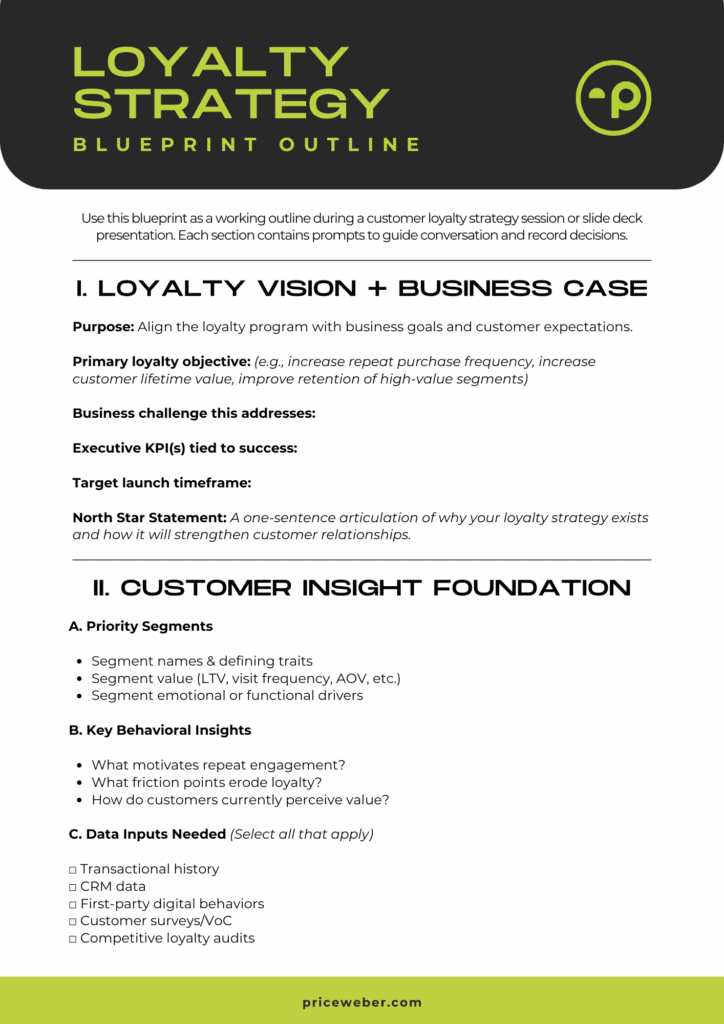
LOYALTY STRATEGY BLUEPRINT OUTLINE
Use this blueprint as a working outline during a customer loyalty strategy session or slide deck presentation.
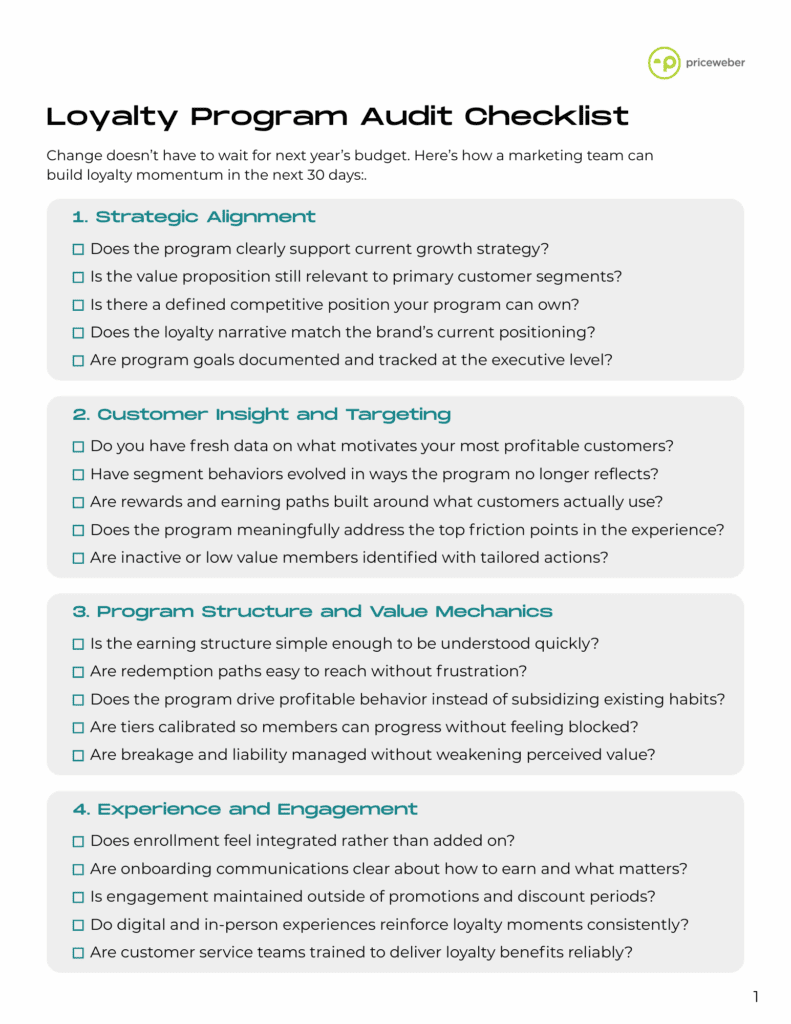
LOYALTY PROGRAM AUDIT CHECKLIST
Use this checklist to quickly evaluate whether your loyalty program is still meeting business needs and delivering value that customers notice.
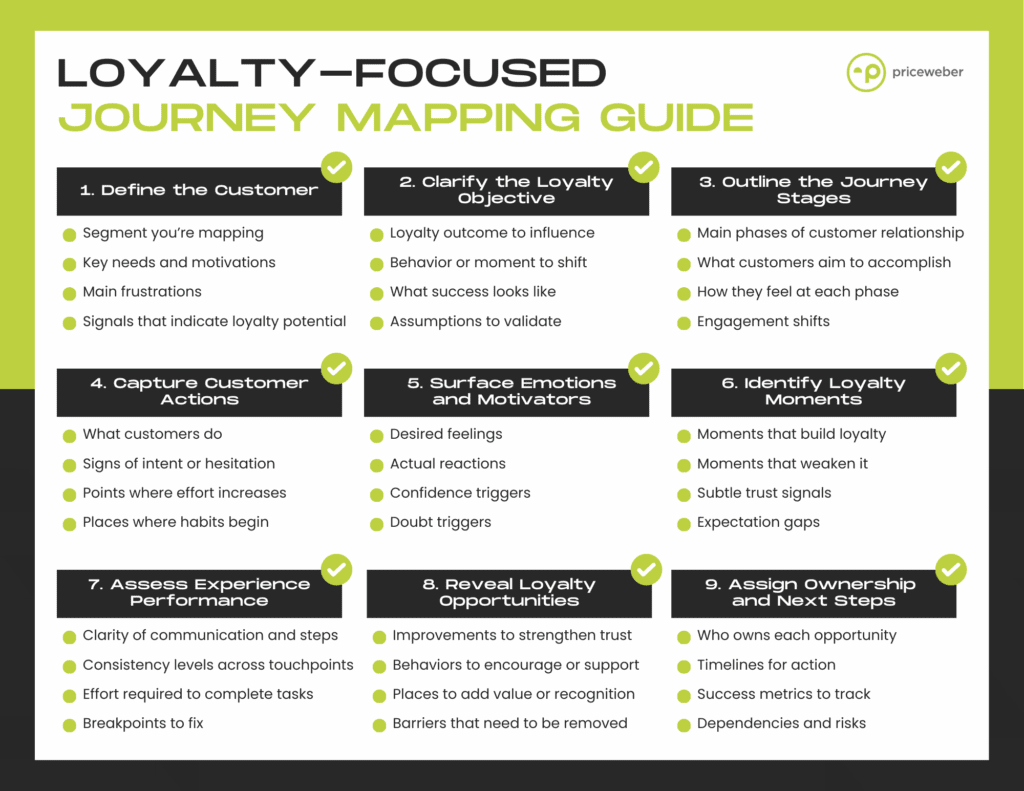
LOYALTY-FOCUSED JOURNEY MAPPING GUIDE
Use this template to look at each stage of the customer experience and capture what helps loyalty grow or slip.
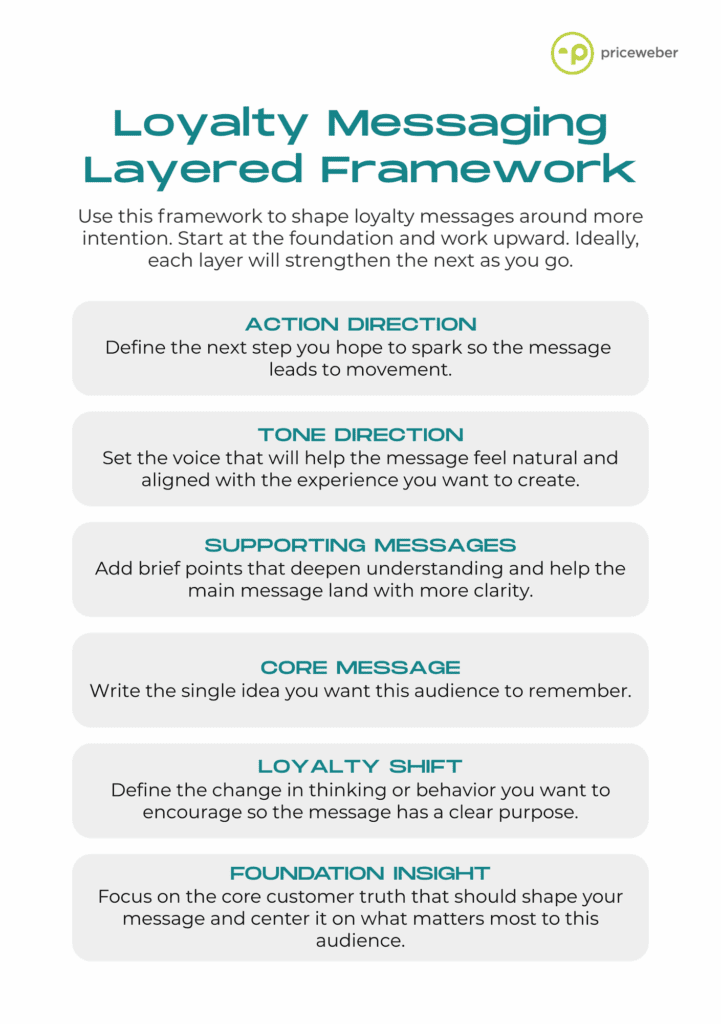
LOYALTY MESSAGING LAYERED FRAMEWORK
Use this framework to shape loyalty messages with more intention. Each messaging layer strengthens the one above.
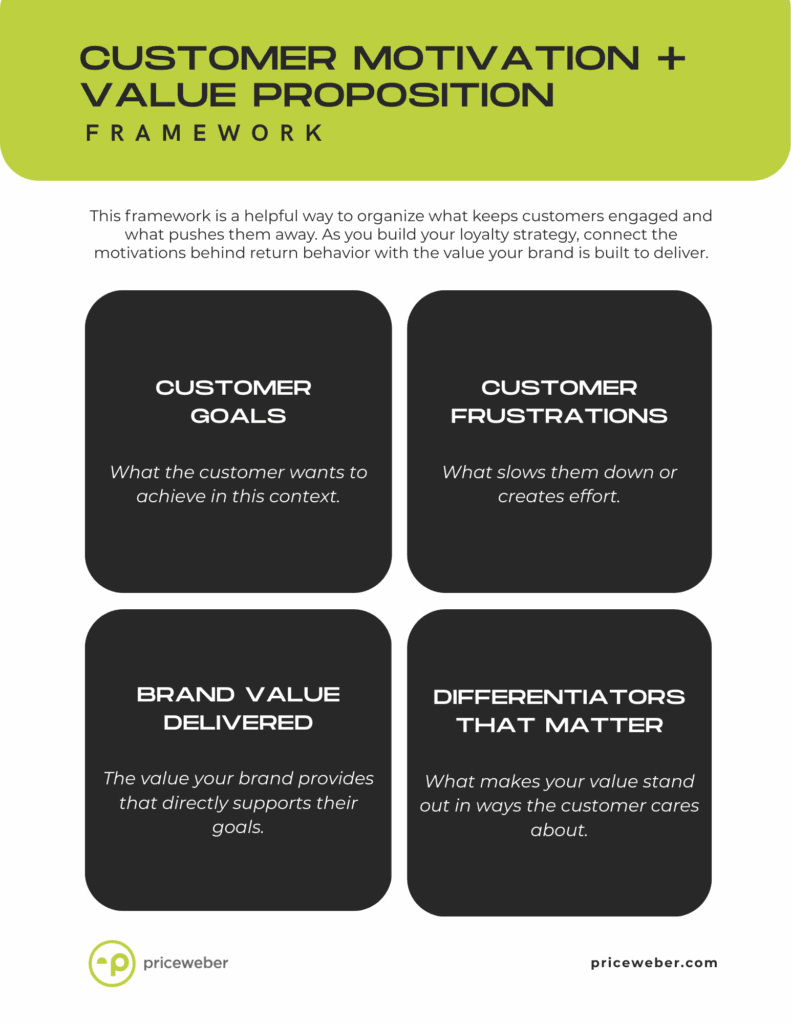
CUSTOMER MOTIVATION & VALUE PROPOSITION FRAMEWORK
Use this framework to align customer motivation with the value your brand creates as you develop or review your loyalty strategy.
Frequently Asked Questions
A modern loyalty strategy blends data driven personalization with experience design. It moves beyond basic incentives and encourages deeper customer connection. If your current program relies mostly on discounts, this is a strong moment to explore relationship focused updates.
Review engagement levels, repeat purchase trends, active member counts, and redemption activity. Compare these indicators to your results from the prior year. Any downward movement or prolonged stagnation signals a need to reevaluate your structure and messaging.
A strong strategy includes a clear value promise and meaningful reward choice. It also depends on easy participation, brand connection, thoughtful use of first party data, and ongoing testing. Use these elements as a reference when evaluating your current plan.
A full review once each year is ideal, supported by quarterly health checks. Fast moving categories may require monthly refinements or targeted adjustments. If your approach has remained unchanged for more than a year, you likely have room for improvement.
Behavioral information, preference signals, digital activity patterns, and lifecycle markers carry the most value. If your program uses only basic transactional records, expanding your data inputs can lift relevance and retention.
Personalization is now a baseline expectation. Customers respond best to offers and messages shaped by their habits. Assess whether your program delivers individualized communication or relies on broad segments with limited nuance.
Transactional loyalty produces near term activity. Emotional loyalty produces enduring retention and advocacy. Healthy programs cultivate both so customers stay active through benefits and through brand trust.
Begin by locating friction points related to value clarity or experience quality. Then introduce improved onboarding, targeted incentives, recovery campaigns, and refined tier structures. Review whether your current plan includes tools for nurturing early stage or mid stage segments.
Focus on repeat purchase rate, active member share, lifetime value, redemption behavior, engagement behavior, and churn. Also compare members and non members to understand the program’s incremental impact. Trends across these indicators will highlight strengths and gaps.
Provide consistent recognition across store, web, mobile, and support environments. Ensure unified profiles, seamless earning, flexible redemption, and synchronized communication. When channels operate independently, loyalty weakens.
B2C strategies rely on personalization and emotional attachment. B2B strategies center on long term partnership, value added services, performance based rewards and account level insight. If your organization serves both, evaluate whether each audience receives the right approach.
Loyalty data reveals real customer behavior and identifies high value segments. These insights can shape content, promotions, product planning, and brand positioning. If you currently use loyalty data only for targeting, you may be overlooking important strategic signals.
Yes. Consistent experience quality and personalized engagement can produce strong loyalty without a points system. Many organizations create meaningful retention gains through customer experience improvements, community involvement, exclusive access and service enhancements.
ROI reflects incremental revenue gains, reward costs, operational costs, and retention improvement. A current year model helps teams understand which elements of the strategy produce the strongest lift. If you have not recalculated ROI recently, this is a good time to update your assumptions.
Important trends include zero party data collection, AI supported personalization, sustainability driven engagement, premium membership tiers, and community oriented experiences. Use these developments to identify new opportunities that support your objectives.