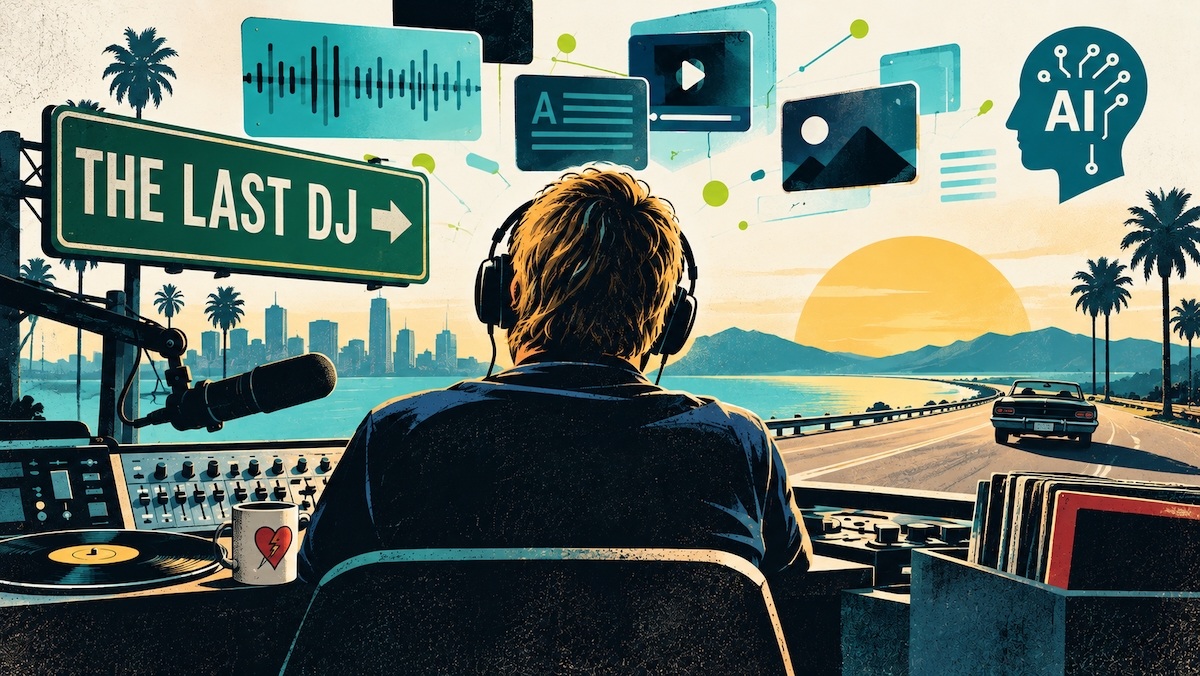

I was driving home from PriceWeber’s office Tuesday when a Tom Petty song came on that I hadn’t heard in years. “The Last DJ.” I’ve always loved the song, but this time it hit differently.
Petty released it in 2002, when consolidation was changing radio. The song tells the story of a DJ watching more decisions about what gets played move away from the people behind the microphone. Eventually, he has enough and heads to Mexico, where he can do things his own way again.
Then came the lyric that stopped me: “there goes your freedom of choice,” followed immediately by a warning about losing “the last human voice”.
Twenty-four years later, you could be forgiven for thinking Petty wrote it about 2026.
We’ve Been Here Before
There’s plenty of anxiety right now about what AI is going to do to creativity. And I get it. AI can write a competent headline in seconds. It can generate dozens of visual concepts before a designer could finish a first sketch. It can help create presentations, videos, images and copy at a speed that would have been hard to imagine a few years ago.
We’re also starting to recognize its fingerprints. Certain phrases. Certain images. Certain ideas. Work that is polished and perfectly respectable, but somehow feels familiar before you’ve finished looking at it. A sea of sameness.
But I don’t believe that’s where this story ends.
New technologies have disrupted creative expression before. And every time, there’s an uncomfortable period when we wonder what we’re going to lose. Then people figure out what else they can create.
The DJ Didn’t Lose
That’s the part of Petty’s song I’ve been thinking about most. The Last DJ leaves American radio because there isn’t room for someone who wants to choose his own records and say what he thinks.
Radio certainly changed in the years that followed. But individual voices didn’t disappear. Podcasts exploded. YouTube created entirely new kinds of broadcasters. Independent musicians found audiences without waiting for radio programmers to discover them. Social platforms handed just about everyone a microphone. Some of what followed has been brilliant. Some of it has been terrible. That’s freedom of choice for you.
But the human voice survived. We found new microphones. I think we’ll do it again.
New Tools Need Ideas
We’ve been experimenting with this ourselves at PriceWeber. For ROW 94, Dierks Bentley’s bourbon brand, we faced a pretty specific challenge: how do you create some of the connection people feel with Dierks at a concert or meet-and-greet when he can’t physically be there?
One answer was a life-sized hologram of Dierks at Louisville Muhammad Ali International Airport, welcoming travelers to Bourbon Country, telling the ROW 94 story and pointing them toward the product nearby. During the first tasting event, the activation moved three months of inventory in two hours.
The technology made it possible. But “we have access to hologram technology” isn’t an idea.
The interesting part was deciding what to do with it.
That’s the opportunity I see in AI, too. The most interesting creative people won’t be the ones who can generate the most things with it. Eventually, practically everyone will be able to do that. They’ll be the people who look at everything these new tools make possible and ask: What can we do now that we couldn’t do before?
Technology keeps giving us new microphones. Creativity is still deciding what to say into them.
Last month, I wrote about how making competent content is getting cheaper, and why that’s increasing the value of genuine human experiences.
But there’s another side to that equation.
When everyone has access to the same creative tools, the ability to produce something impressive becomes less of a competitive advantage. The real opportunity is in knowing what to create in the first place.
That’s where things get interesting for creative people. If almost anyone can produce a beautiful commercial, what commercial are you going to make? If everyone can generate 50 headlines, which one are you going to choose?
What do you find funny? What have you experienced that causes you to see something differently? What can your brand credibly say that its competitors can’t?
Those questions aren’t becoming less important. They’re becoming more valuable.
Maybe It’s Time to Be a Little Rebellious
AI can give us options. Data can tell us what happened. Best practices can tell us what’s worked before. But somebody still has to decide whether any of it is interesting. That’s where creatives have a particular responsibility right now.
Use AI. Learn it. Push it. Find things it lets you do that weren’t economically or technically possible before.
Be willing to say the technically excellent idea isn’t good enough. Push the concept another round. Put some fingerprints on it.
Bring your sense of humor, strange reference points, taste, experiences and stubborn opinions into the work. Make something your competitor couldn’t run simply by changing the logo.
Be a bit of a pain in the rear. Because distinctiveness has business value. Marketing has to get noticed before it can do much of anything else.
Resist the default.
Don’t Fire the DJ
I don’t know where AI ultimately takes creative industries. Nobody does. But I have a lot more confidence in people than some of the conversation right now would suggest.
We’re remarkably stubborn about expressing ourselves. Give us a new tool and we’ll imitate what came before for a while. We’ll overuse it. We’ll establish conventions. We’ll make plenty of junk. And then somebody will do something nobody expected. Someone always does.
Maybe Petty was right about the forces pushing us toward sameness. But the DJ didn’t lose. He just found somewhere else to play his records. We’ll find new places, too. Some of them may be built with AI. Because the creative rebellion we need isn’t a rebellion against the technology. It’s a rebellion against the default. The machines are going to become extraordinarily good at giving us options.
We still get to choose what gets played.
Keep it weird. Keep it human. And keep the records spinning.
Let Me Hear From You!
Tell me what you think, did it spark any ideas for you? Do you disagree and care to share a different perspective? Whatever it is, I’m here for it, let me know what’s on your mind and as always, happy to compare notes about marketing challenges!
Our Articles Delivered
Signup to receive our latest articles right in your inbox.